


Co-hosted by Global Champions the European Union, Iceland, Honduras, Nauru, Panama, Portugal, and the UAE, Day 4 of the High-Level Dialogue on Energy Ministerial Forums focused on the role of clean energy as an enabler of the Sustainable Development Goals. Here are the key takeaways from UNDP’s Energy team.
1) Key Announcements
-
Nauru announced a comprehensive and ambitious Energy Compact which aims to achieve 50% electricity generation from renewable sources by 2023; a 30% improvement in energy efficiency by 2030 from a 2021 baseline; and the electrification of 20% of the vehicle fleet by 2030.
-
GOGLA, the professional association for the off-grid industry, committed to delivering improved electricity access for 1 billion people by 2030 through deploying the latest innovations in distributed solar technology, efficient appliances, and decentralized business models.
-
The city of Ithaca in New York aims to implement a community choice aggregation programme through which the city will procure below-average cost, 100% renewable energy from selected energy service companies. Through this, the city expects to have at least 30% of buildings in the city rely on 100% renewable energy by 2024 increasing to 60% by 2027 and 100% by 2030.
-
H.E. Mr. Roberto A. Ordoñez Wolfovich, Minister of Energy of Honduras, announced plans to present an Energy Compact during the HLDE in September, noting we are at a crucial moment to promote actions to achieve clean energy.
-
H.E. Mr. Gudlaugur Thór Thórdarson, Minister for Foreign Affairs and International Development Cooperation of Iceland, committed to delivering an Energy Compact by the HLDE in September, referencing its work with IRENA, World Bank, and SEforALL to continue to contribute in other countries, including Small Island Developing States where sustainable energy in the Blue Economy is particularly important.
-
H.E. Mr. João Galamba, Deputy Minister and Secretary of State for Energy, Portugal, committed to an Energy Compact on Green Hydrogen, which will create at least two hydrogen valleys in Portugal, and will pay particular attention to most vulnerable groups, noting access to safe, secure and affordable energy is essential to deliver SDG agenda
Find all Energy Compacts announced to date here.
2) Key Observations
-
Three billion people without access to clean cooking is unacceptable; one billion people are still served by health facilities that do not have access to energy is unacceptable. We cannot continue with business-as-usual in the era of climate crisis and COVID pandemic. A just and inclusive energy transition is a critical step for green recovery and has the potential of saving millions of lives, protecting billions of people as well as protecting our planet.
-
Hundreds of clinics and facilities lack of electrification in Africa: energy access must include access to health care as a core priority.
-
Investing in energy transition can bring significant development co-benefits, every dollar spent on the clean energy transition will generate between $3-7 return.
-
Of the 5 billion jobs in the world right now 1.4 billion jobs are dependent on climate stability.
-
There needs to be an ambitious skills agenda for the just transition; less than 10% of current NDCs include worker skills, while only 20% of NDCs plan for human capital.
-
We need to think holistically and adopt a comprehensive set of policies to support the transition. In addition to policies that help enable the deployment of renewables we think about: Field of industrial policy – help to create viable supply chain – including access to credit; Supporting business incubation, capacity building, forming regional industrial clusters; Education and training and active labour market policies; Enable private sector investment and strong public investment strategies.
-
Financing diesel and coal might be cheaper in the front end but the catastrophic climate change and long-term effects on the local economy is no longer theory - we have seen it. It is not the best economic solution.
-
Governments are pushing and promoting universal energy access but are making attaining that goal difficult by keeping fossil fuel subsidies in place.
-
Borrowing from SDG16, it is important to focus on justice and reliable institutions to anchor our systems to be more fair and more inclusive. We need a long-term vision that is inclusive, including women, youth, disabled and refugee communities, and to embed participation in decision making and more inclusive financing.
-
Women leadership in development and donor agencies have a huge role to push for more inclusive role for women.
-
Energy has largely been male dominated; things are moving in the right direction, yet we still have a long way to go to change stereotypes and social norms. Companies also are realising they can achieve improved results by pursuing gender equality.
-
Sustainable energy is a key component of food security and the circular economy, to achieve objectives of a green economy the focus cannot only be on innovation of production and materials but also clean energy and efficiency.
-
We must use the HLDE to mobilise the needed political leadership. We have all necessary technologies available for us to get through to 2030. We now need a massive push for innovative technology, a high price on carbon and use public resources to correct market failures.
3) Thematic Working Group on Enabling SDGs through Just Transitions Report launch
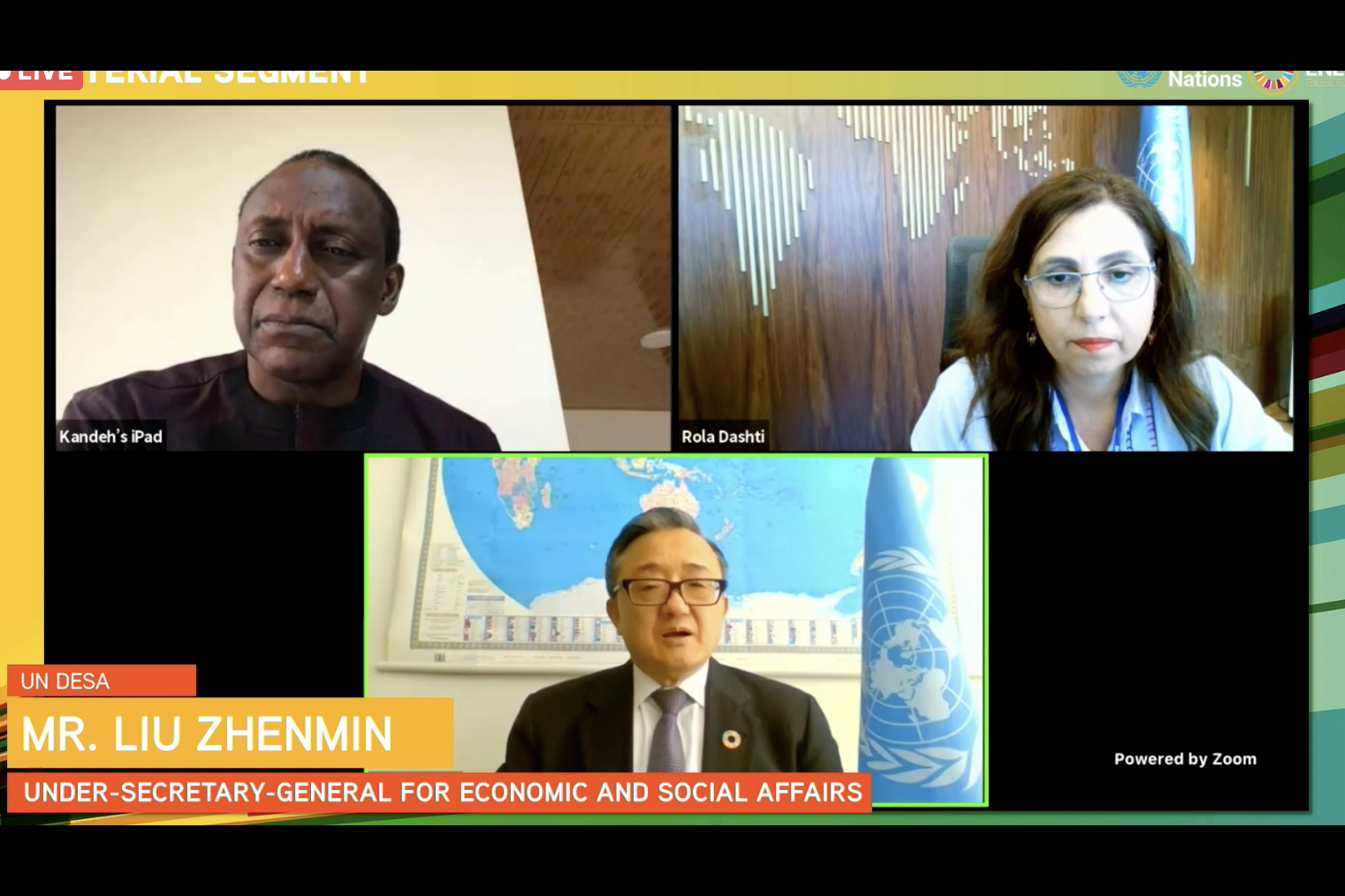
The Working Group’s co-leads were the UN Economic and Social Commission for Western Asia, UN DESA and WHO launched their report, which highlights that all the energy transition pathways must be just and inclusive in order to accelerate collective actions to deliver on the SDGs and the Paris Agreement.
The report outlines 8 recommendations that will help drive forward a clean energy transition that enables the achievement of the 2030 Agenda:
-
Every country and region should integrate achievement of the SDGs as a guiding framework into the planning and implementation of their own transition pathways towards clean and sustainable energy.
-
Implement a sustainable energy transition strategy with social equity and inclusiveness at its centre to enable the SDGs.
-
Integrate access to affordable, reliable, sustainable, and modern energy, including access to electricity and clean cooking, as the central pillar of inclusive, just, energy-transition strategies.
-
Accelerate the integration of gender equity into energy transition pathways.
-
Enable transformational change by promoting systemic approaches in the energy transition to achieving the SDGs and the climate goals, while ensuring energy security.
-
Track progress and integrate an Energy for SDG Impact Framework into energy transition strategies.
-
Strengthen multi-stakeholder partnerships to leverage the transformational potential of energy for enabling the SDGs.
-
Ensure that the energy transition pathways are sustainably designed and implemented to enhance synergies and reduce trade-offs with other SDGs
Watch the video summary and download the report for more information.
3) UNDP Spotlight: Youth for sustainable energy & ‘Warm Data’ sessions
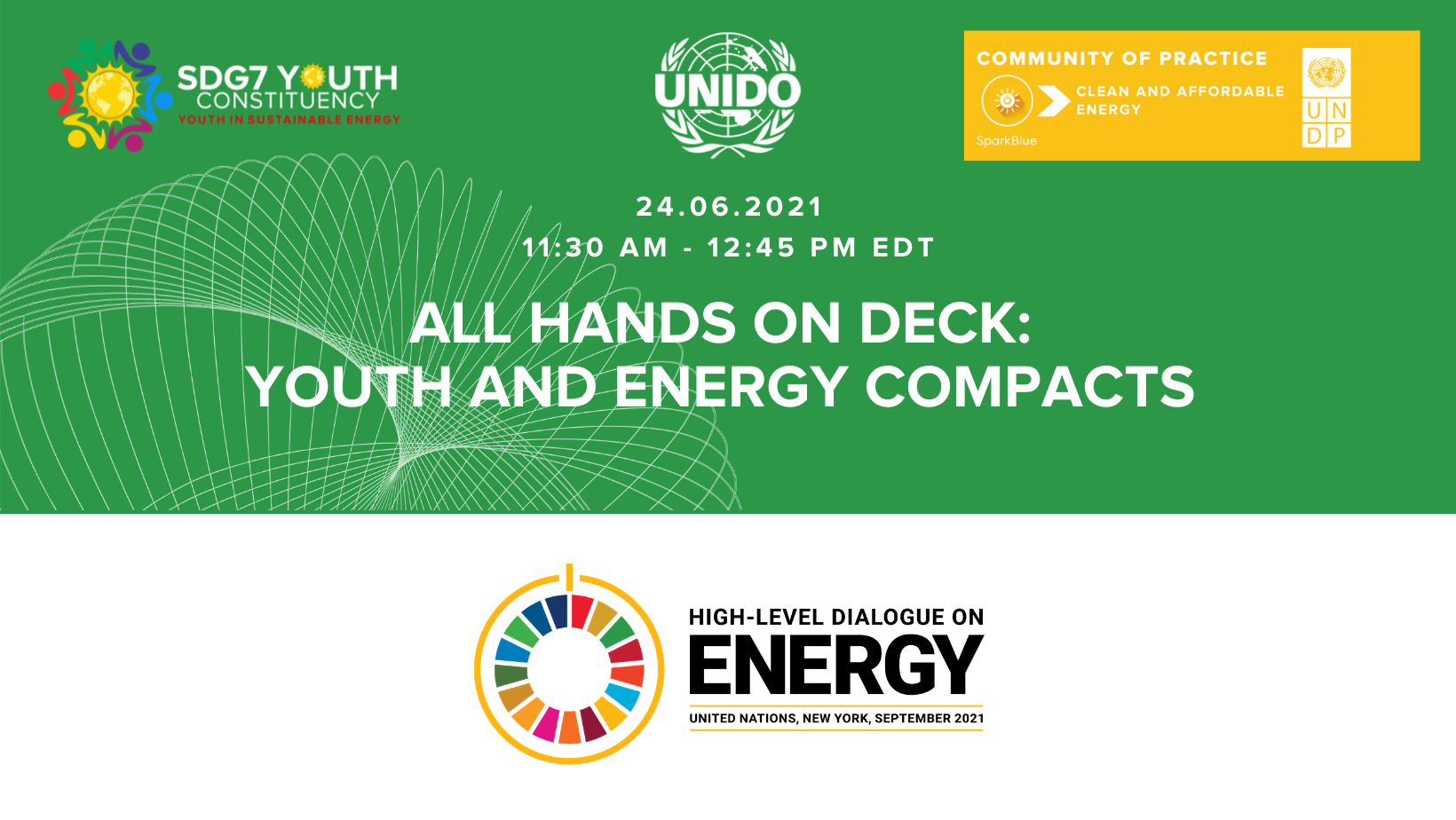
Co-hosted by the SDG7 Youth Constituency, today’s side-event built on Youth and Energy Compacts on the ongoing effort across the UN system - including the Energy Community of Practice Youth Consultation with over 300 young leaders from across the world - and by youth organisations for greater inclusion of youth in the global energy agenda and focused on two key questions: How can youth benefit from the Energy Compacts? How can youth contribute to the Energy Compacts? Young energy leaders presented a set of recommendations, which will be integrated in an upcoming toolkit on how stakeholders can account for the needs of youth in formulating their Energy Compacts and how youth organisations can participate in the process.
USAID/Power Africa and SEforAll organized a side-event to explore with various practitioners the opportunity to formulate a collective Energy Compact on health facility electrification. The compact could provide a platform to raise the attention on this sector and dimension the scale of interventions and financial resources or commitments that may be required. Between now and August, SEforAll will coordinate with different stakeholders the formulation of this compact. UNDP has been invited to join this effort in view of its activities related to Solar for Health.
Throughout the week, UNDP has also been hosting a series of Warm Data workshops, designed to bring people together to help understand the complexity of systems – and how to change them.
4) Tomorrow: Day 5 on Finance and Investment; Grand Closing & Way Forward
The Forums are soon coming to a close! Last but not least, tomorrow’s sessions from 6am to 11am will focus on discussing finance and investment for sustainable energy.
The Grand Closing will then take place from 11am to 12pm and outline a way forward towards the High-Level Dialogue on Energy in September. Don’t miss the closing speeches by the United States Special Presidential Envoy for Climate John Kerry and by UNDP Administrator Achim Steiner. Find the full programme here, and watch live here.
***
Read UNDP's summary of yesterday's proceedings in our daily recap blog here
Full summary, including video recordings of key moments by IISD’s Earth Negotiations Bulletin here. Follow @IISD_ENB on Twitter for breaking updates.
For more information about the HLDE and the Ministerial Forums this week:
-
Press Release - Joint press release from UNDP and SEforAll sharing expectations for the ministerial forum meetings this week.
-
Working Group Report Launches - Across the week, 5 x reports from each of the working groups are being released. Find executive summaries and links to the reports as they're released at this link.
Join! Check the Run of Show (subject to change). Register at this link to join, listen in and engage in the process.
We are all advocates: Share your support on social media by sharing, retweeting, quote tweeting or posting your own messaging in support of the messages you hear. Please add hashtags to your post so that your messages can be better tracked #HLDE2021 #SustainableEnergy
Please consider tagging @UNDP and @UNDPClimate in your post if you have the opportunity. Need inspiration? Suggested Social Media messages can be found here or have look at what we're putting out from @UNDP and @UNDPClimate for inspiration, including our daily Twitter thread offering a recap of the day's proceedings.
Please log in or sign up to comment.