


Co-hosted by Global Champion Countries Brazil, Chile, Colombia, Denmark, Germany, India, Nigeria, Poland, Spain, and UK with Theme Co-leads IRENA, UN ESCAP and UNEP, Day 3 of the High-Level Dialogue on Energy Ministerial Forums focused on how the energy transition. Today saw a number of key announcements from Member States. Here are the key takeaways from UNDP’s Energy team.
1) Key announcements
-
India announces ambitious renewable energy commitments with renewable energy targets of 450 GW of installed capacity by 2030 at an unprecedented pace and price.
-
Netherlands announces its Energy Compact, which outlines a whole-of-society approach and the mobilization of partners across the board for clean energy.
-
Germany’s Energy Compact pledges, among other things, to reach a 30% share of renewable energy in gross final energy consumption by 2030 and to support its partner countries in reducing energy poverty, improving energy efficiency and developing and implementing transformative energy policies away from fossil fuels towards renewable energies.
-
Denmark’s Energy Compact aims for the country, among other things, to cover 100% of the Danish electricity consumption with renewable energy by 2028 and to support energy transition in 16 countries through bilateral cooperation sharing Danish expertise and know-how.
-
Colombia, Chile, Dominican Republic and the IDB announce RELAC, the Renewable Energy in Latin America and the Caribbean Energy Compact, with a regional at least 70% participation of renewable energy in the power matrix by 2030.
-
Brazil offered two Compacts – one on biofuels to lower the emissions from the Brazilian transportation sector, and one for green hydrogen to increase R&D and implementation
2) UNDP Administrator Achim Steiner key remarks of the day
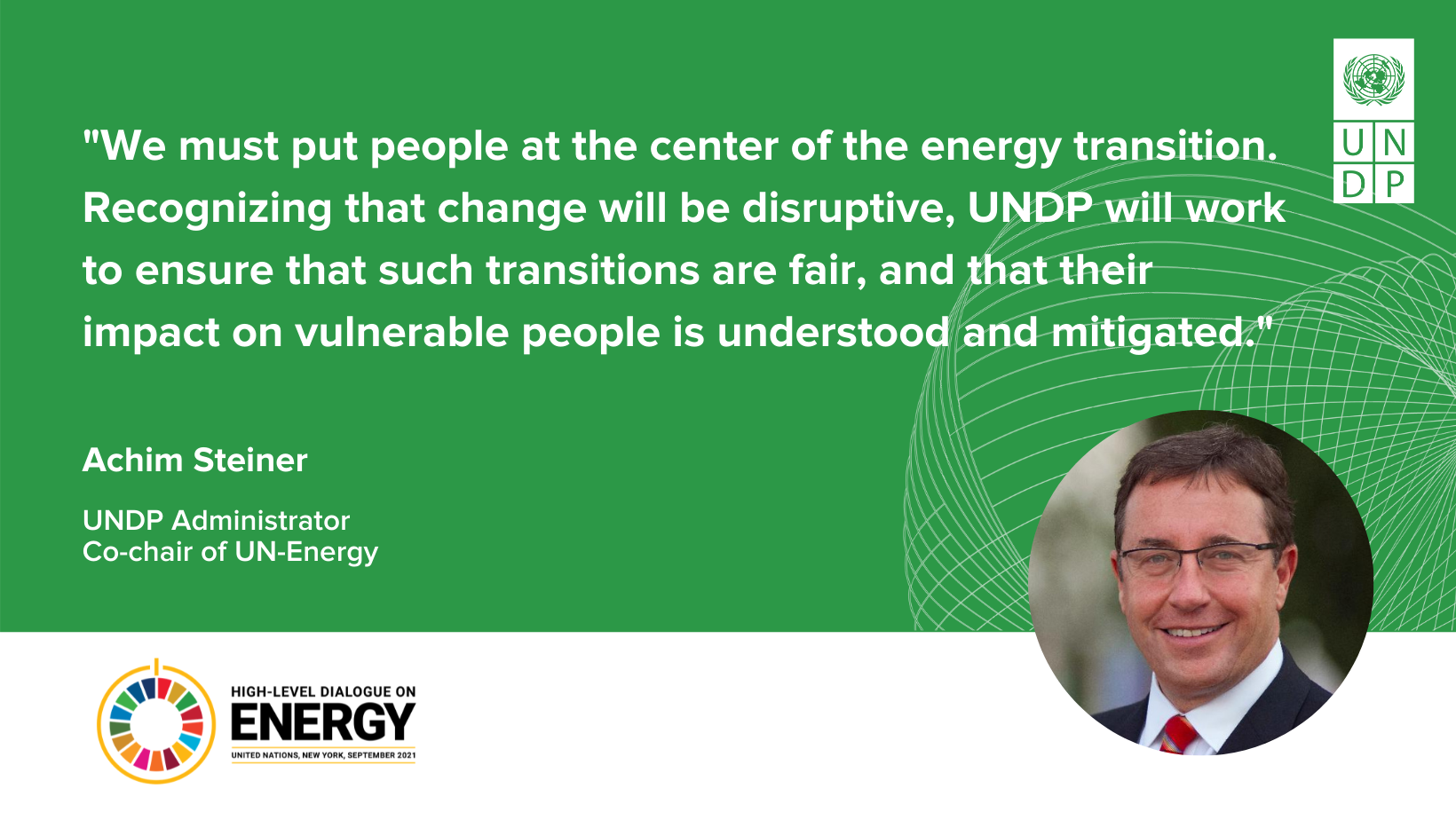
As the Master of Ceremony for the Ministerial Session on the Energy Transition, Achim Steiner outlined what must be our guiding principle for a just transition: “We must put the people at the center of the energy transition. Recognizing that change will be disruptive, UNDP will work to ensure that such transitions are fair, and that their impact on vulnerable people is understood and mitigated.”
As a guest of the UN Spokesperson daily media briefing, Achim Steiner gave a mid-week update on the HLDE Ministerial Forums to the media, highlighting that "the High-Level Dialogue on Energy is not just a one-day summit in September. It is a series of significant shifts. This is an energy revolution, and at its heart is how the international community can cooperate for just transitions."
3) Key observations
-
Ghana emphasized that globally we are all moving away from high-energy intensity to a path of low carbon development. New standards are awaiting parliamentary approval to move from voluntary to mandatory standards for appliances from kitchen to factory.
-
The continent of Africa has been on the receiving end of obsolete technologies for far too long. This is one of the main obstacle to continent’s ability to leap frog. Investors need to acknowledge enormous market potential in Africa.
-
The Alliance for Rural Electrification offered an Energy Compact commitment to achieve 500 million additional people with access, 5 million new green jobs, and avoid 1 billion tonnes of CO2 by 2030.
-
Korea offered to play a bridging role between developed and developing nations
-
Energy transition is not an option, it is an inevitability that cannot be delayed any longer. Transition needs to move 4 to 6 times faster. We must immediately end the financing of unabated coal power.
-
UNEP Chief, Inger Andersen noted, “Governments need to stop talking about it, they need to now start doing it. By all means commit to net-zero 2050 in your NDC but what are you doing now because we cannot wait for 30 years”.
-
How to overcome social acceptance and policy orientation, especially in emerging economies, is the real challenge – we need to tackle the political and social angles, that is the barrier to off-shore wind and new deployment.
-
Cross-border renewable energy power connections can open enormous potential for social and economic growth using smarter and expanded energy grids to enhance resilience of supply but will also enhance the resilience of overall energy systems from increased vulnerability from extreme weather and climate shift.
-
Coal issue is not only an energy issue but a social and political issue. We need a broader framework to put all together. The World Bank is investing 1 billion dollars in just transition.
-
The HLDE, in the run up to COP26, offers a chance to further strengthen, refine and deliver partnerships to bring forth clean energy solutions, which are affordable, attractive and accessible to all, to put the whole world on a faster track to Net-Zero.
4) Thematic Working Group Energy Transition Report launch
The co-leads of the Working Group on the energy transition IRENA, UN ESCAP and UNEP launched their report. Its overarching message is clear: the energy transition can no longer be limited to incremental steps. It must become a transformational effort, a system overhaul, based on the rapid upscaling and implementation of all available technologies to innovate for the future.
The report outlines 11 key recommendations to ensure that the emerging energy system must promote resilient economies and societies for a more inclusive and equitable world:
-
Rapidly scale-up deployment of available energy transition solutions to reach 8000 GW1 of renewables by 2030 with due consideration to different contributions by individual countries.
-
Increase the average annual rate of energy efficiency improvement from the current 0.8% to 3% through the implementation of all available technologies while supporting further innovation.
-
Invest in physical infrastructure to enable the energy transition.
-
Countries of the Organisation for Economic Co-operation and Development (OECD) should phase out coal by 2030 and redirect international energy financing towards the transition.
-
Mainstream energy policies into economic, industrial, labour, educational, and social strategies.
-
Establish medium and long-term integrated energy planning strategies, define decarbonization targets, and adapt policies and regulations to shape energy systems that boost sustainable development.
-
Create regional energy markets to facilitate the integration of renewables, promote cross-border power grid connectivity and trade, and further reduce costs through economies of scale.
-
Intensify international co-operation on energy transition to meet the 2030 Agenda for Sustainable Development and avoid future catastrophic climate change impacts.
-
Develop sustainable transport roadmaps.
-
Tailor labour and social protection policies to the specific needs of each region and country.
-
Make the energy transition a participatory enterprise
Watch the video summary and download the report for more information.
5) UNDP Spotlight: Financing Energy Projects in SIDS with the Climate Investment Platform
In concert with the Alliance of Small Island Developing States, the Climate Investment Platform hosted a side event called Financing Energy Projects In Small Island Developing States. HE Dr. Walton Webson, Permanent Representative of Antigua & Barbuda to the United Nations, Chair AOSIS, provided opening remarks. A highly engaging panel about how to de-risk energy investments in the SIDS with the Asian Development Bank, Fiji's Ambassador to the UN, Director of Renewables from the Energy Ministry of Dominican Republic, and the CEO of Sunergise was moderated by Denmark's Ambassador to the UN. Adriana Dinu delivered closing remarks. Recording available here.
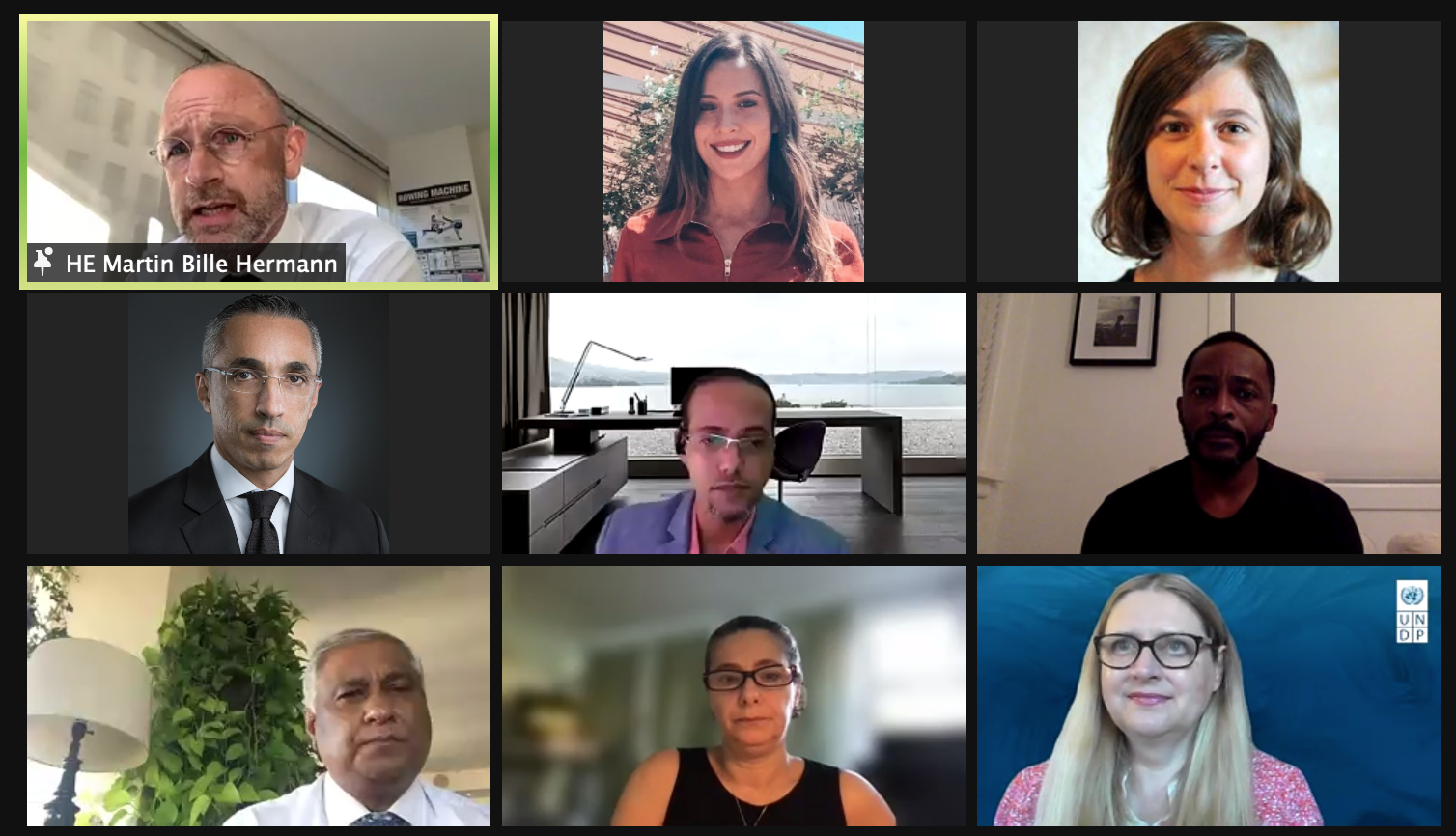
Adriana Dinu and Marcel Alers also spoke at the side-event to formally launch the Working Group on Energy Access report. Recording will be available at a later date.
6) Tomorrow: Day 4 on Enabling the SDGs through Just Transitions
Day 4 of the Forums is dedicated to Enabling the SDGs through just transitions. Tune in here from 6am EST.
Don’t miss our side-event on how Youth can contribute to global sustainable energy efforts, co-organised with the SDG7 Youth Constituency, at 11:30am EST. Register here
Full summary of the day available here.
Follow live updates on UNDP Climate’s Twitter account throughout the week, and join the conversation with the hashtag #HLDE2021.
Please log in or sign up to comment.