
INTRODUCTION
Drug policy is deeply connected to sustainable development, shaping human rights, health, poverty, gender equality, and the environment. UN Member States are increasingly adopting evidence-informed, rights-based, and inclusive approaches - as called for in the UN System Common Position on drug-related matters. Recent UN resolutions - 68/6 and 68/3 - demonstrate growing support for such policies and for amplifying the voices of affected communities.
Launched in 2019 by UNDP, WHO, UNAIDS, OHCHR, and the University of Essex, the International Guidelines on Human Rights and Drug Policy offer a practical framework to reform drug laws while upholding rights, health, and dignity in line with the three UN drug conventions. Five years on, this consultation provides an opportunity to review progress, share good practices, address challenges, and explore partnerships. Its final report will be shared by UNDP with the UN system Task Team on the Common Position and other relevant bodies.
ABOUT THIS CONSULTATION
In the next 3 weeks, we would like to consult and collect information on drug policy work.
This consultation is public, open to all.
Consultation period: 20 October - 14 November, 2025
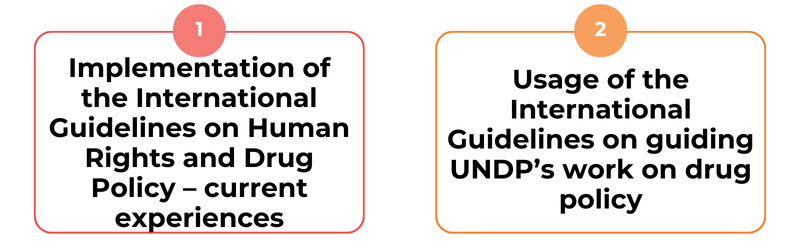
Thematic areas of discussion

Audience
The consultation is open to all interested stakeholders, with particular emphasis on the participation of:
- Community-led and community-based organizations, including networks of:People who use drugs;
- People living with HIV;
- Small-scale and traditional cultivators of drug-linked crops;
- Formerly incarcerated persons;
- Women, Indigenous Peoples, youth, and minorities affected by drug policies.
- Civil society organizations working on drug policy reform, harm reduction, human rights, sustainable livelihoods, and public health;
- Experts and practitioners from academia, public health, development, and legal sectors working in partnership with communities and civil society;
- Stakeholders involved in the design, implementation, monitoring, and evaluation of alternative development programmes;
- Government and multilateral partners working in collaboration with civil society and communities to advance evidence-based drug policy reforms.

Impact
As experts working on drug policy reform, your help to improve and illustrate what is happening and should be happening on the ground moving, challenges faced, and best practices to promote evidence-based, health-focused, and human rights-centred policies.
Your feedback will be summarized in a report that will inform the UNTT members and other relevant groups and stakeholders engaged in drug policy reform.
For more information
Contact : Luiza Veado, Policy Specialist, UNDP HIV and Health Group, [email protected]
Any technical issues can be shared with: [email protected].



