

As COP29 underscores the critical need for global climate action, UNDP is excited to present our insights on South-South and Triangular Cooperation (SSTC) as a pivotal approach to addressing climate challenges.
The Paris Agreement recognized the importance of international cooperation on adaptation efforts, taking into account the needs of developing countries, especially as they are particularly vulnerable to the adverse impact of climate change. South-South cooperation is an effective modality for strengthening local capacity for and country ownership of climate action.
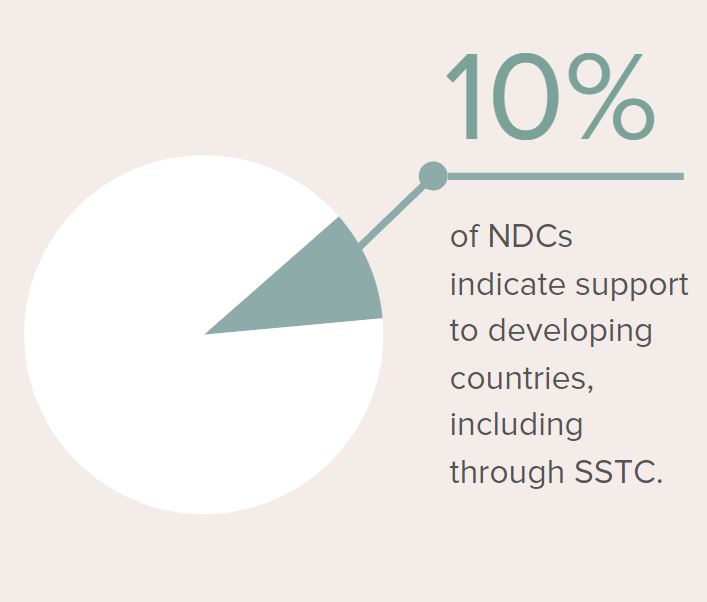
In the 2022 Synthesis Report of NDCs, 10% of countries indicated that they provide, or intend to provide, support to developing countries, including through South-South Cooperation.
The First Global Stocktake in 2023 acknowledged progress in areas facilitated through SSTC to enhance international cooperation for climate action, notably knowledge sharing and technical assistance to support technology transfer, capacity-building for the implementation of priorities of countries in the Global South, cooperation to accelerate the pace of technology adoption. It established the “Roadmap to Mission 1.5°C”, a flagship effort to enhance international cooperation to raise the ambition of the next round of NDCs.
South-South and triangular cooperation is an essential modality to address the disproportionate impacts of climate change and mainstream climate adaptation into national agendas, facilitate technology transfer, build capacity, and foster common positions in climate negotiations.
How is UNDP advancing climate action through South-South and Triangular Cooperation?
South-South and Triangular Cooperation (SSTC) approaches have been integral in UNDP’s efforts to address climate mitigation and adaptation. UNDP promotes South-South and Triangular Cooperation approaches to advance integrated solutions under the Nature Pledge and Climate Promise and its multi-billion-dollar portfolio of environmental projects.
As part of the UN-REDD programme, UNDP strengthens the linkages between agriculture and forestry to promote sustainable commodity production and climate action through South-South cooperation.
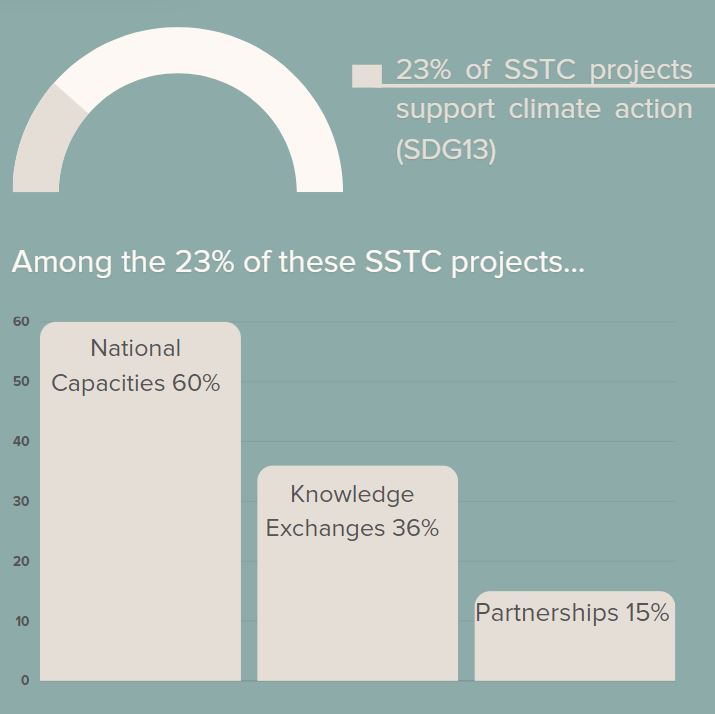
In 2023, 23% of projects across UNDP’s SSTC footprint (134 out of 585 projects) also supported climate action (SDG13). Of these, 60% focused on strengthening national capacities, 36% brokered knowledge exchanges, while 15% supported partnerships between countries in the Global South.
Some Notable Initiatives from 2023:
UNDP, with support from Sweden and UK, has established the Climate Finance Network for the Asia Pacific region. It is a peer-to-peer network to assist Ministries of Finance in partnership with sector ministries, subnational governments, private sector and other development cooperation partners to identify and scale up climate finance innovations in 18 countries in Asia and the Pacific. Through technical advisory, capacity building, and knowledge sharing, the network supports countries on gender and social inclusion, gender responsive climate budgeting and expenditure tracking, formulation of climate finance mobilization strategies, and mainstreaming climate finance in planning especially for adaptation and resilience.
UNDP has partnered with the EU on Enhancing Knowledge and Evidence to Scale Up Climate Change Adaptation in Africa with the Africa Adaptation Initiative (AAI). Through series of South-South exchanges, the capacity of African experts to develop bankable proposals was strengthened and a continent-wide programme concept on adaptation project incubator was developed. In addition, AAI supported the orientation of over 150 experts from across over 30 countries in Africa on the basic concepts and instruments of climate and disaster risk financing (CDRF), including how to better protect vulnerable communities from socio-economic and climate-related disasters by increasing the role of insurance and risk financing and expanding knowledge on data topics such as weather forecasting mechanisms.
Through the UN-REDD Programme, UNDP is supporting 13 countries (Cambodia, Colombia, Costa Rica, Cote d’Ivoire, Democratic Republic of Congo, Ecuador, Ghana, Indonesia, Kenya, Mexico, Peru, Uganda and Viet Nam) to implement REDD+, enhance the ambition and delivery of forest solutions in their NDCs, and access climate finance for REDD+ through technical assistance and a comprehensive global knowledge management approach that includes policy dialogue and South-South exchange, as well as targeted advocacy on topics such as social inclusion and gender equality.
In collaboration with WHO and GEF, the initiative “Building Resilience of Health Systems in Pacific Island Least Developed Countries to Climate Change” collaborate in 10 Asia Pacific countries to facilitate catalytic partnerships across countries, training and capacity development of climate change and health specialists in the countries. The initiative strengthens institutional capacity to integrate climate risks and adaptation into health sector planning, improves surveillance and/or early warning systems, supports regional cooperation and knowledge sharing, and integration of health into national adaptation plans.
The Small Grants Programme on Indigenous Peoples’ Access to Energy supported grant-making in seven participating countries. In Timor Leste, the programme strengthened the customary governance system known as Tara Bandu as part of decentralized solar energy production, and initiated preparations for South-South exchange and knowledge transfers with Indigenous-led micro-hydro schemes funded by the SGP in Malaysia.
The Global Plastics Innovation Program is a three year-long program to develop and scale up innovative circular solutions to plastic pollution in China, Nigeria, Sierra Leone, South Africa, Tunisia, and Vietnam. The program focuses on upstream and midstream solutions to reduce plastics use and seeks to create green job opportunities for young people. It will also promote South-South exchanges and learning on innovative solutions to tackling plastic pollution.
In 2021, UNDP launched a trilateral SSC project between China, Ethiopia, and Sri Lanka to encourage the adoption of productive biogas, biomass, and solar technologies in Ethiopia. This SSC project involves co-financing, technology transfer, joint design, collaborative implementation and skills transfer between the three countries.
In the Asia Pacific region, UNDP facilitates exchanges and peer-to-peer learning between Kazakhstan, Kyrgyzstan, Uzbekistan and Mongolia to advance country-led green finance solutions to implement National Biodiversity Strategies and Action Plans, raising the ambition and impact of Nationally Determined Contributions. UNDP convened a South-South exchange of policy options on debt for nature swaps, to help countries strengthen debt sustainability and economic governance, learning from what works, and in turn accelerating progress on the SDGs.
In Indonesia, UNDP supported the government in creating the SDGs Government Securities Framework, through which various sovereign thematic bonds have been issued since 2018, including Green Sukuk, SDGs Bonds, and Blue Bonds. These bonds have collectively mobilized nearly $10 billion to finance and refinance projects aimed at climate action, social justice, and sustainable ocean management. South-South exchanges were facilitated between Indonesia and various countries to share that experience, including Uzbekistan, Bangladesh, Cambodia, Tanzania, and Laos, among others.
In 2023, UNDP partnered with the IMF South Asia Regional Training and Technical Assistance Center to facilitate exchanges between ten countries (Bangladesh, Bhutan, India, Maldives, Nepal, Sri Lanka, Cambodia, Lao P.D.R., Philippines, and Vietnam) on solutions to address challenges in increasing green expenditures.
UNDP partnered with China International Development Cooperation Agency (CIDCA) under the Global Development and South-South Cooperation Fund (GDSSCF) on a new initiative to increase preparedness and response capacity to disasters in 10 Asia Pacific and African countries of the Global South through the development of tailored and accessible early warning systems. It will revolve around three crucial pillars: Data and Information Management; Last-Mile Communication and Community Outreach; Governance.
These initiatives exemplify how SSTC acts as a catalyst for innovation and resilience, aligning with global goals to tackle climate change. They underscore the importance of collaboration, leveraging shared experiences, and fostering partnerships to accelerate sustainable development.
Please find the flyer as attached to showcase our initiatives. For more insights on SSTC and our climate action work, visit the South-South and Triangular Cooperation Platform on SparkBlue or explore our latest initiatives via UNDP’s Data Futures Exchange (DFx).

Please log in or sign up to comment.