


Spotlighting South-South and Triangular Cooperation in the implementation of the Sevilla Commitment — Insights from the Financing for Sustainable Development Report 2026
With only four years to go until the target date of the 2030 Agenda for Sustainable Development, increasing global fragmentation, rising trade barriers, heightened geopolitical tensions and conflicts, and widespread climate related disasters are challenging progress towards achieving the Sustainable Development Goals. An increasing number of developing countries, especially the poorest and most vulnerable, confront large unmet SDG spending needs amid an overall financing squeeze, simultaneously facing declining aid, rising costs, and heavy debt service burdens.
Against this challenging backdrop, the Financing for Sustainable Development Report 2026 (FSDR 2026), the first comprehensive assessment since the adoption of the Sevilla Commitment at the Fourth International Conference on Financing for Development (FFD4) in 2025, highlights the increasingly vital role of South-South and triangular cooperation (SSTC) in the global development financing landscape. Across the report's analysis, SSTC emerges not as a peripheral complement, but as a dynamic and expanding force in trade, investment, development cooperation and data, that is reshaping how the Global South finances its sustainable development.
SSTC in the Sevilla Commitment and the Sevilla Platform for Action
The Sevilla Commitment, adopted at FFD4 in July 2025, provides a renewed global framework for financing sustainable development. The Commitment explicitly affirms that South-South cooperation is a complement to, not a substitute for, North-South cooperation, while acknowledging its expanding role and unique comparative advantages. It sets forth actions to further strengthen SSTC across multiple action areas, from development cooperation, where it calls for scaling up the volumes of South-South cooperation (para. 36(e)), enhancing its impact and effectiveness (para. 36(f)), strengthening triangular cooperation (para. 36(g)), and reinforcing regional mechanisms for South-South cooperation (para. 36(h)), to data and monitoring, where it calls for broader reporting by South-South cooperation providers and the systematic measurement of South-South cooperation flows (para. 64(b)).
To accelerate implementation, the Sevilla Platform for Action (SPA), a companion framework of over 130 high-impact initiatives launched alongside the Commitment, includes several initiatives that directly support the SSTC agenda. These include a Community of Practice to Leverage South-South Data, supported by UNCTAD and backed by the newly created South-South Data Fund, which aims to build developing countries' capacities to measure and report their South-South cooperation contributions to the SDGs; the 2030 Pact for Effective Development Co-Operation, which spans commitments on scaling up South-South cooperation, enhancing its effectiveness, and strengthening triangular cooperation; as well as the Public Finance for SDGs Collaborative and the Global Development Initiative, both linked to expanding the scale and impact of South-South cooperation. Together, the Sevilla Commitment and SPA signal an evolved understanding of SSTC: in a fragmenting world where finance squeezes are impeding development progress, South-South and triangular cooperation is poised to play an ever more critical role in the global development financing framework and its implementation.
The Rise of South-South Trade
Geopolitical tensions, conflicts and rising trade barriers are fragmenting the global trading system, with developing countries, particularly LDCs, LLDCs, and SIDS, bearing the brunt. Yet amid this turbulence, the FSDR 2026 highlights that South-South trade is profoundly reshaping global trading and production patterns, offering new opportunities for Global South. According to the report, the value of South-South trade has increased more than fourfold over the past two decades, far outpacing the doubling of South-North trade over the same period. Developing countries’ markets now account for a much larger share of developing countries’ exports, almost 60 per cent in 2024. Beyond growth, the report emphasizes that South-South trade cooperation serves as a tool for building economic resilience: trade diversification through regional trade agreements and South-South partnerships can help countries better withstand external shocks, enhance value addition, and reduce dependence on volatile global supply chains. In this context, the rapid rise of South-South trade represents not only a shift in trading patterns, but a strategic pathway toward more resilient and diversified development.
Bridging the South-South Data Gap
Under the Sevilla Commitment, efforts are ongoing to strengthen South-South data collection and empower countries to communicate their role and priorities in development cooperation based on their own data and narratives. Better data on South-South and triangular cooperation is essential to strengthen their effectiveness, impact, and recognition in the broader development cooperation landscape, yet South-South cooperation still largely lacks systematic data.
A landmark step was taken in 2025, when the first-ever South-South cooperation data was reported to SDG indicator 17.3.1 using the voluntary United Nations Framework to Measure South-South Cooperation, a framework developed by and for the Global South, with UNCTAD serving as custodian under a mandate from the UN Statistical Commission. The Framework captures all modalities of South-South cooperation through three groups: financial support, including grants and direct cash transfers, non-financial support that can be monetized, and non-monetized non-financial flows. A Manual for the Framework was published in 2025 to guide data collection and reporting.
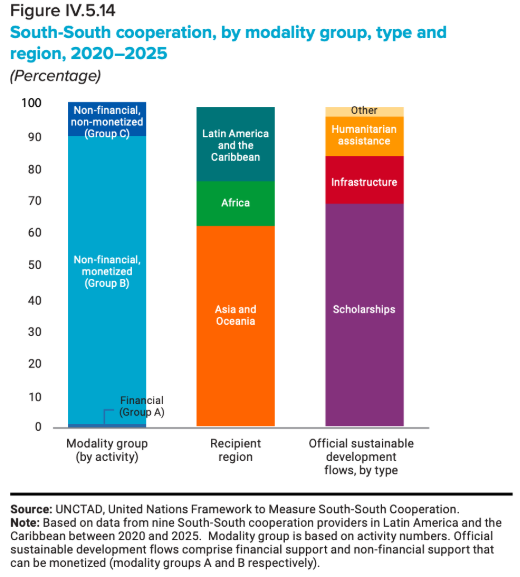
Initial data from nine pilot countries in the Latin America and the Caribbean region provide groundbreaking insights: only 31 of 4,368 South-South cooperation activities (1 per cent) were delivered through financial means, with 401 non-financial activities remaining non-monetized, underscoring that traditional financial flow metrics systematically underestimate the true scale and nature of South-South cooperation. In terms of value, around 70 per cent of official sustainable development grants were provided as scholarships, 15 per cent as monetary contributions to infrastructure projects, and 13 per cent as humanitarian assistance. Geographically, almost two thirds (63 per cent) were directed to countries in Asia and Oceania, 24 per cent to other Latin American and Caribbean countries, and 13 per cent to African countries, while support for LDCs accounted for only around 7 per cent of the total.
Efforts to expand this data ecosystem are underway: a Community of Practice to Leverage South-South Data was launched under the Sevilla Platform for Action to provide peer support and technical sharing. To date, 66 developing countries have requested immediate support to start collecting data nationally. The momentum is clear, but so is the gap between ambition and resources. Closing that gap will be essential to ensuring that South-South cooperation is not only recognized but systematically measured, reported, and ultimately strengthened as a pillar of the global development financing architecture.
Please log in or sign up to comment.