


This consultation is now closed. |
Network managers and coordination focal points will drive the operational side of the strategy. Your insights are crucial on how to implement partnerships on the ground, support field networks, and the broader network of assets. We will be providing guiding questions focused on practical tools, processes, and coordination mechanisms, while still linking back to the strategic priorities. We look forward to engaging with you!
This section focuses on contributions and partners which usually provide non-financial contributions. These are networks or institutions contributing to UNESCO’s programme delivery and outreach efforts through advocacy, data collection, expertise, knowledge resources, operational capacities, programme implementation, research capacities, among others. For instance: NGOs, C2Cs, Institutes, Chairs, Creative Cities, youth networks, ASPNet, as well as assets such as networks of designated sites.
As a first step, we invite you to review the infographic below. It provides a snapshot of the networks and assets that form the UNESCO ecosystem. These networks and assets present opportunities to develop innovative revenue-generating mechanisms and business models, and to mobilise individual donors and high-net-worth individuals in support of UNESCO's mandate. They also present potential for coalition-building.
Your feedback and updates will help ensure the information is accurate, relevant, and reflective of current realities.
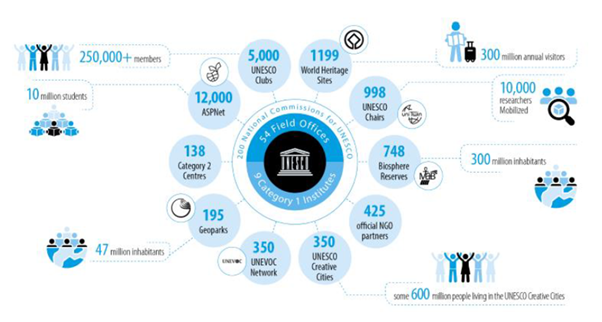
As a second step, we welcome your thoughts on the following question:
Comments (2)
On behalf of the UNITWIN/UNESCO Chairs Programme, we suggest to make the graphic look more modern and update the number of UNESCO Chairs and UNITWIN Networks (1096 UNESCO Chairs and UNITWIN Networks). Doc annexed with useful links.
Use the new logo for UNESCO in the centre of the graphic and UNITWIN/UNESCO Chairs Programme (Picture1 attached below).
General comment:
The proposed document by BSP provides an overview of UNESCO’s collaboration opportunities and challenges with its partners in line with the C4 and C5. However, it might further emphasize a strategic long-term engagement with new and non-traditional partners and its NETWORKS by prioritizing:
a) their contributions to cross-cutting priorities, interdisciplinary approaches and outputs;
b) a multistakeholder platforms;
c) a dialogue across all UNESCO’s Networks.
To streamline multilateralism and to enhance UNESCO’s multidisciplinary mandate: regrouping all UNESCO’s interdisciplinary Networks to better address the multi-stakeholder strategy that will enable to design new modalities of intersectoral /interdisciplinary cooperation.
Partnerships within the UNITWIN/UNESCO Chairs Programme
For 32 years now, the Unitwin/UNESCO Chairs Programme witnesses a great demand by the Member States, and Institutions of Higher learning world-wide, which see in it a concrete way to contribute to UNESCO’s action and ideals in its different domains of competence. This can be explained by the increasing number of applications received each year.
More than 1000 UNESCO Chairs and 50 UNITWIN Networks, hosted by over 900 higher education or research institutions in 130 countries increasingly operate across disciplines and regions by advancing research, developing joint teaching or training programmes, and engaging with communities
Recognized as UNESCO’s intellectual partners by its Comprehensive Partnership Strategy adopted by UNESCO in 2019 (Doc 207 EX/11), UNESCO calls on the UNESCO Chairs to feed global debates and to contribute to reflections in its priority areas and global priorities: Africa and Gender Equality, but also to advancing its mission.
UNESCO Chairs contribute to the national, regional and international influence of their universities aimed at promoting UNESCO's programs by achieving the SDGs of the 2030 agenda and beyond, by strengthening synergies with the Organization and with other UNESCO networks by providing their intellectual contributions in line with the Organization's mandate.
The Chairs and UNITWIN Networks also have an impact on sustainable human development in playing fully their role as: Think tanks in key domains of development, such as Education for Sustainable Human Development and Peace, the reduction of the digital divide, climate change, bioethics, cultural diversity and several others; and Bridge builders between the academic world and civil society in terms of research results and the political decision making notably by implementing UNESCO’s main recommendations and normative instruments (2021 Recommendation on Open Science, and educational materials as Open Educational Resources in line with the 2019 Recommendation on Open Educational Resources, and 2023 Recommendation on Education for Peace, Human Rights and Sustainable Development).
The Chairholders serve as UNESCO advisory boards, prize juries, and scientific committees. They also contribute as key informants to UNESCO evaluations and surveys, and participate in UNESCO events as speakers, facilitators and deliver keynotes. These activities are typically not remunerated but are considered part of the Chair’s planned work and are supported by the hosting universities or departmental funds.
Leverage impact of UNESCO’s NETWORKS and more particularly UNESCO Chairs and UNITWIN Networks :
Some recommendations:
· Foster interdisciplinarity and cross-sectoral communication of the Unitwin Programme;
· Attract new partners to make known the strengths of the Network ;
· Facilitate partnership modalities across Networks and traditional partners;
· Regular trainings and updates on partnerships;
· Create an interactive internal and external platform for all UNESCO’s partners and Networks.
Dear colleagues,
Thank you very much for your rich contribution – this is exactly the kind of forward-looking inputs we were hoping to receive through the SparkBlue platform.
The reflections on the UNITWIN/UNESCO Chairs Programme and its strategic role within UNESCO’s partnership ecosystem are especially valuable. Your emphasis on long-term engagement with new and non-traditional partners, fostering interdisciplinary collaboration, and creating multistakeholder platforms aligns closely with the direction we are aiming for in the strategy.
Additionally, your points on fostering cross-sectoral communication, attracting new partners, and developing interactive platforms will be considered as we refine the strategy’s implementation tools.
Thank you again for your time and contribution !