
SDG 16 Survey Initiative
What is the SDG 16 Survey ?

- Support the data production on peace, justice and inclusion (SDG 16): This Initiative provides insights into the complex realities at national and local levels. It contributes to monitoring the 11 out of 24 indicators under goal 16, which rely on nationally representative population surveys to produce reliable and robust data.
- Unveil some of the hidden truths of how violence, discrimination, inequality and injustice manifest within communities and identify actionable entry points to tackle some of these persistent challenges effectively.
- A rigorous measurement tool: The SDG 16 Survey Questionnaire has undergone extensive development and testing, including quality assessment by experts, cognitive and pilot testing.
- An internationally recognized survey tool: The Initiative has been welcomed by the 53rd United Nations Statistical Commission, urging Member States to implement the survey, particularly in contexts where there is limited availability of data.
- Coverage of key domains for Goal 16: The survey addresses critical data gaps essential for national SDG 16 monitoring. It informs evidence-based policies and programmes on the prevention and fight against corruption, discrimination, trafficking in persons, violence, as well as in promoting governance and access to justice.
The SDG 16 Survey has been designed with the following considerations:
- International and time comparability: The SDG 16 indicators and their definition are applicable and relevant in most countries and comparable across countries, time, cultures, languages, and types of government. A main set of questions will be replicated in each country to ensure global comparability.
- National contexts, inclusion of optional standard items: The survey allows for adjustments based on different levels of national development, context and capacities through the inclusion of additional survey questions to contextualize and localize its indicators. Where possible, the SDG16 Survey framework can be complemented with regional and national indicators and adapted to the national context. To furthermore contextualize indicators, each indicator is disaggregated by various socio-demographic criteria.
- Modular design: The SDG16 Survey is designed to be applied as a standalone household survey. Alternatively, countries can implement each of the survey modules separately or incorporate parts of the survey into ongoing data collection. The design sets out a recommended sequencing of the eight sections covering most of the survey-based indicators of the SDG 16 indicators framework.
- Dimensions of survey quality: The design of the SDG 16 survey strives to achieve statistical quality of its indicators through relevance, accuracy, timeliness, accessibility, interpretability and coherence.
The 2030 Agenda for Sustainable Development (SDGs) was endorsed in 2015 by the Member States at the 70th United Nations General Assembly. Member States pledged that all countries and all stakeholders, acting in collaborative partnership, would implement this plan, leaving no one behind. Specifically, they committed that “We are determined to foster peaceful, just and inclusive societies which are free from fear and violence. There can be no sustainable development without peace and no peace without sustainable development”.
This commitment was translated into Sustainable Development Goal 16: Promoting peaceful and inclusive societies for sustainable development, providing access to justice for all, and building effective, accountable, and inclusive institutions at all levels. SDG 16 is considered an enabler of other goals, and increasingly countries are including it as part of their national development plans and strategies.
Measuring progress on peace, justice, and inclusion is rapidly improving. The methodology for all indicators under the goals is progressively refined with all indicators upgraded from Tier 3 to Tier 2 in 2020, i.e. from a status of “no internationally established methodology or standards are yet available for the indicator, but methodology/standards are being (or will be) developed or tested”, to “Indicator is conceptually clear, has an internationally established methodology, and standards are available, but countries do not regularly produce data”. While the methodology now exists, there continues to be limited availability of data and it is necessary to strengthen statistical systems to produce the indicators on a consistent and regular basis.
UNDP, UNODC, and OHCHR developed the SDG 16 Survey Initiative in response to newly established methodologies and limited data availability. This initiative provides a high-quality, rigorously tested population survey tool to support the production of data and the measurement of progress on many survey-based indicators under Goal 16. Countries can address critical data gaps cost-effectively by implementing the survey either as a stand-alone tool or by integrating selected modules into existing surveys, depending on their specific needs and data priorities.

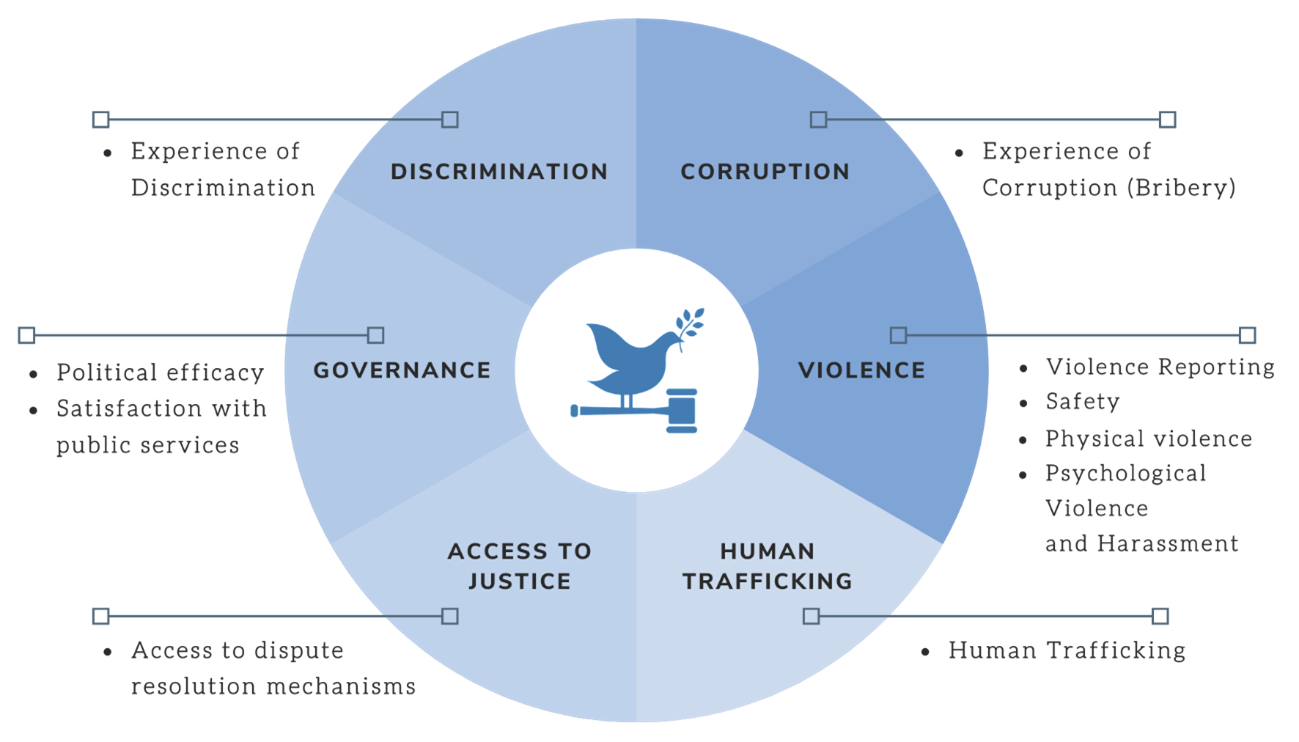
The SDG 16 Survey offers an internationally standardized and tested instrument to collect data for the computation of 13 Sustainable Development Goals indicators, divided into six modules, on Access to Justice (OECD, UNDP, UNODC), Corruption (UNODC), Governance (UNDP), Discrimination (OHCHR) and Human trafficking (UNODC) and Violence (UNODC).
Disaggregation allows data users to compare population groups and to understand the situations of vulnerable groups. Currently accepted metadata[1] documents recommend the following disaggregation to be provided with each individual indicator. Besides these recommendations, countries are encouraged to disaggregate by all relevant and available variables in their national context.
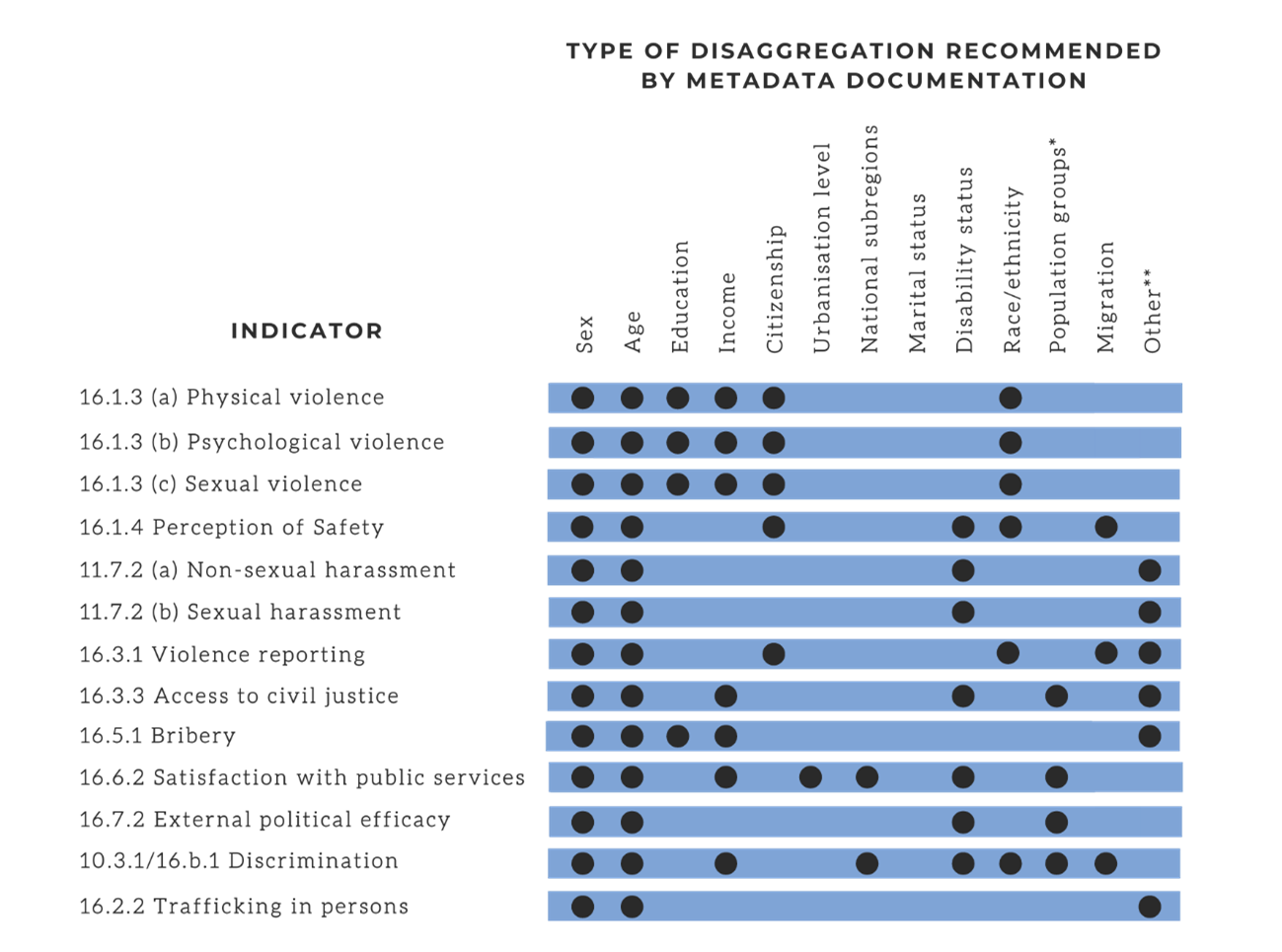
*Population groups are relevant in the respective national context.
*This includes indicator-specific analytical criteria, such as thedisaggregation place of occurrence for 11.7.2, type of crime for 16.3.1, type of dispute resolution mechanism in 16.3.3, type of official in 16.5.1 and type of exploitation in 16.2.2
[1]Documents that provide additional information on the data, including but not limited to data reporter, definitions, concepts, classifications, data sources, data collection types and other methodological considerations.
The SDG16 Survey Questionnaire underwent several rounds of testing, including quality assessment by experts, cognitive testing and pilot testing. It was piloted in eight countries, whose experiences contributed to refining the instrument.
An expert consultation was conducted in 2020, gathering contributions from national and international entities, particularly National Statistical Offices and experts in the domains covered by the survey. This feedback ensured the development of a high-quality instrument for monitoring progress on the SDG 16 indicators and facilitated the incorporation of diverse country contexts and experiences into the SDG 16 Survey Questionnaire.
Cognitive testing of the questionnaire was conducted between June and December 2020 in Cabo Verde, El Salvador, and Kenya. The cognitive test collected quantitative data to evaluate the honesty of response, recollection with longer introductory questions, difficulty, and security in remembering. An in-depth qualitative analysis of the questions was conducted, paying particular attention to information on verbal responses and body language obtained through observation. The comprehensive information collected during the cognitive testing in the three countries led to a revision of the questionnaire modules before initiating the piloting phase.
The piloting of the SDG 16 Survey was initiated in February 2021 in Cabo Verde, El Salvador, Kazakhstan, Kenya, Tanzania, Togo, Tunisia and Somalia. The participating countries were selected based on their interest, availability to collect data within the specified timeframe, and fulfilment of minimum requirements related to sampling, technical capacity, survey structure, fieldwork and follow-up. In all countries, the piloting was conducted by, or in partnership with, the National Statistics Office, with support from UNDP, UNODC and OHCHR.
The questionnaire was finalized in mid-2021, accompanied by an implementation manual designed to support the data collection and computation of the SDG16 indicators. The manual provides comprehensive guidance on key activities across all stages of statistical survey development and implementation, from the planning phase to data analysis and results dissemination. It serves as a practical roadmap for implementation while acknowledging the existence of national practices, protocols, and procedures adopted by countries.
Implementation Manual and Questionnaire

Capacity Building
UNODC, UNDP, and OHCHR conducted Regional Training on measuring SDG 16 indicators to enhance the technical capacities of national authorities in producing, analyzing, and disseminating relevant data. The training also aims to strengthen the organizational framework and foster a 'data community' that facilitates the exchange of experiences and addresses challenges among data producers and users. It covers 19 SDG indicators, including those collected through the SDG 16 Survey.

